

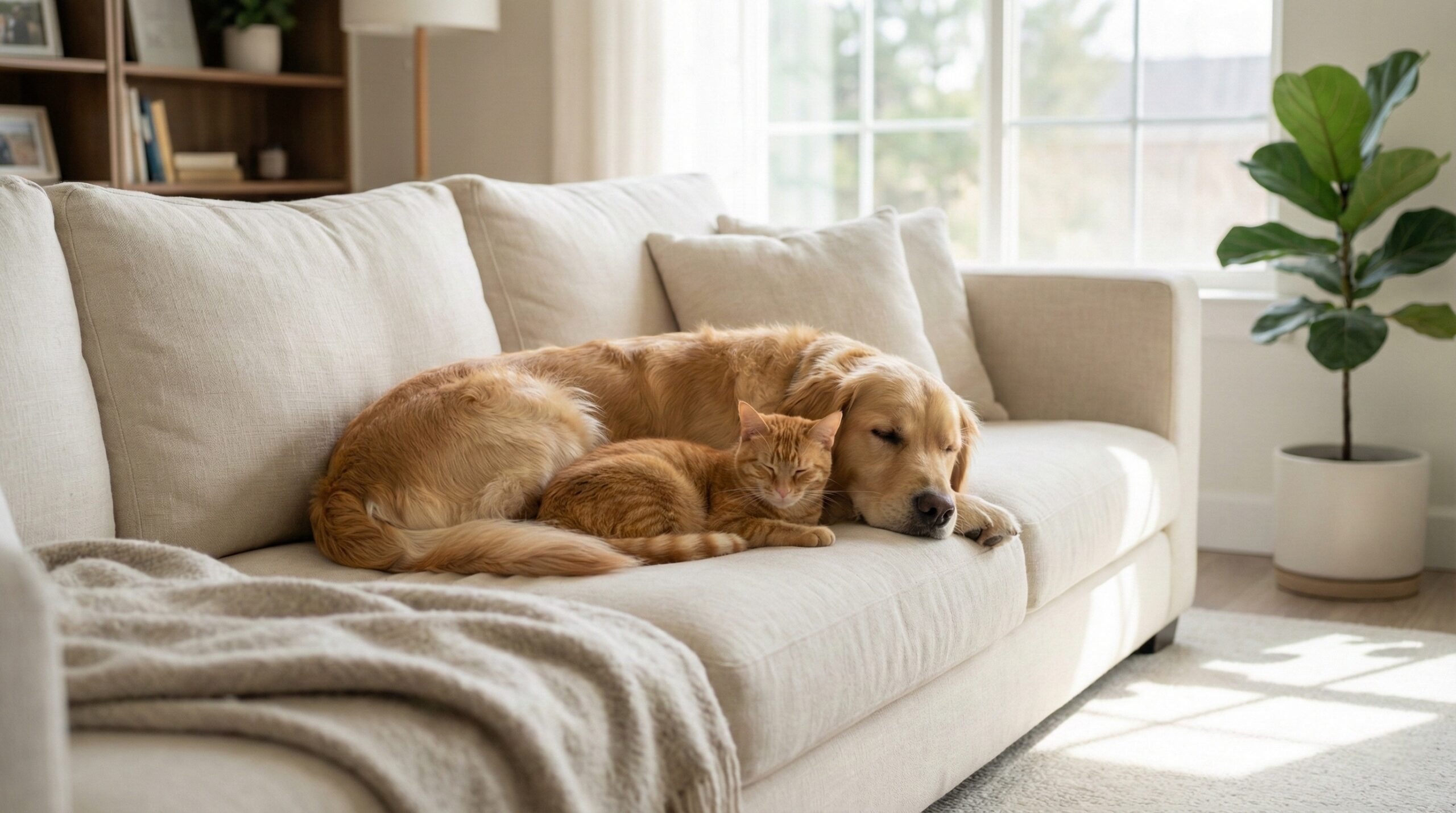
If your dog keeps sneaking bites from the cat’s bowl, you’re not alone. Here’s what “can dogs eat cat food” really means for your dog’s health, what’s usually fine, and when it’s time to loop in a vet.
Need to Know
Our editorial team reviewed the best-available pet guidance and community owner reports to answer this. Dogs can eat small amounts of cat food without it being “toxic,” but it isn’t formulated for a dog’s long-term nutrition and can trigger stomach upset or worse in some dogs. If your dog repeatedly raids cat food — or has vomiting, diarrhea, belly pain, or lethargy — treat it as a diet/safety issue and talk with your vet.
Quick Answer
It depends, because a few mouthfuls of cat food are usually not an emergency for most healthy dogs, but cat food is not appropriate as a regular diet for dogs and can cause GI upset and other health problems over time. If your dog ate a lot at once or shows symptoms, contact your vet for individualized advice.
What This Usually Means
In real-world households, “can dogs eat cat food” often means one of three scenarios: (1) your dog stole a quick snack while you weren’t looking, (2) your dog is repeatedly cleaning up the cat’s leftovers every day, or (3) your dog is refusing dog food but will happily eat the cat’s. Those scenarios matter because a one-time nibble is very different from ongoing access — both in nutrition and in the chances of triggering digestive trouble.
Cat food is designed for cats, which are obligate carnivores with different nutrient requirements than dogs. In practice, many cat foods are more calorie-dense and can be higher in fat and protein than typical dog food, and the vitamin/mineral balance is targeted to feline needs — not canine needs. Organizations like the AKC frequently emphasize that dogs and cats have distinct nutritional requirements; that’s the core reason we consider cat food a “sometimes accident” rather than a “fine to feed” option. Over time, a dog filling up on cat food may miss out on the fiber and nutrient balance dogs do best with, and you can also see weight gain because cat food can pack more calories into a smaller volume.
There’s also the short-term “stomach” angle. When a dog suddenly eats richer food than they’re used to — especially higher-fat foods — vomiting, diarrhea, gas, or belly discomfort can show up within hours to a day. Some dogs are simply more sensitive, and dogs with a history of pancreatitis are a special concern because high-fat foods can be a trigger. If your dog inhaled a large amount of cat food (for example, an entire bowl or a broken-open bag), it’s worth calling your vet for guidance even if your dog seems okay at the moment.
“Yes they can eat it but they shouldn’t, like it’s not going to poison them but obviously cats and dogs are 2 separate species that have different nutritional needs so its definitely way better to feed them something specifically made to meet those nutritional requirements.” r/Pets
One more nuance: the question isn’t only “cat food vs. dog food,” but also which cat food and which dog. Kittens’ foods can be especially rich; some therapeutic or high-calorie cat diets may be even more concentrated. A large, healthy adult dog that snags a few kibbles will often be fine, while a small dog, a senior dog, or a dog with GI disease, kidney disease, or prior pancreatitis may react more strongly. This is why many vets treat repeated cat-food raids like a preventable diet-management problem rather than something to ignore.
What Can Help
- If it was a one-time nibble, monitor and keep meals bland. For many dogs, the most helpful step is simply watching for vomiting, diarrhea, appetite changes, or unusual tiredness for the next 24–48 hours and keeping your dog on their normal diet (or your vet-recommended GI plan if they have one).
- If your dog ate a lot, call your vet for next steps. Your clinic can advise based on your dog’s size, medical history (especially pancreatitis), and what type/amount of cat food was eaten.
- Pick up cat bowls between meals (scheduled feeding). Scheduled feeding for your cat can reduce “all-day buffet” access that encourages repeated dog snacking.
- Feed the cat in a dog-proof spot. A counter-height location, a cat tree platform, a closed room with a baby gate that has a cat door, or a microchip-activated feeder can all help keep cat food out of reach.
- Make your dog’s meals more structured. Offer your dog’s food for a defined window (for example, 10–20 minutes), then remove it. This can reduce grazing and food-switching habits — ask your vet if your dog has health issues that require free-feeding.
- Work on “leave it” and “place” cues around the cat’s feeding area. Training won’t change nutrition, but it can stop the repeated access that turns a minor issue into a chronic one.
- Check whether your dog is underfed or bored. Sometimes the “cat food obsession” is just opportunistic eating, but sometimes it’s a sign your dog needs a diet check (calories, portion size, treat intake) or more enrichment (walks, play, puzzle feeders).
- If your dog refuses dog food but wants cat food, involve your vet early. Sudden pickiness can be behavioral, but it can also be dental pain, nausea, parasites, or other illness. The goal is to avoid “training” your dog to hold out for richer food.
“Put the cat food on the counter or on a cat tree where the dog can’t get it. Offer your dog his food for 15 minutes then take it away. Don’t offer anything better or add toppers. A healthy dog won’t starve themselves. He’s learned if he refuses you’ll give him something better…” r/Pets
A concrete example we see a lot: you feed the cat in the kitchen, the cat wanders off, and your dog “cleans up” the leftovers daily. In that situation, the fix is usually environmental (where and how you feed the cat) more than nutritional wizardry. Once the dog loses access, many mild digestive issues and “mystery weight gain” patterns improve — because the extra calories and richer food disappear.
What to Avoid
- Don’t use cat food as a regular topper to “get your dog to eat.” It often backfires by teaching your dog to wait for the richer option and can make diet balance worse over time.
- Don’t switch your dog fully to cat food. Cat food is not formulated to meet canine nutritional needs long-term, and it can be too calorie-dense for many dogs.
- Don’t ignore repeat raids as “no big deal.” Even if your dog seems fine today, chronic access can contribute to weight gain and recurring GI upset.
- Don’t assume vomiting/diarrhea is “just” the cat food if it persists. If symptoms continue beyond a short bout or keep returning, your dog may need an exam and possibly testing.
- Don’t let a pancreatitis-prone dog get into cat food. High-fat foods are a common trigger; if your dog has had pancreatitis before (or your vet suspects it), treat cat food like a high-risk item.
- Don’t try to “balance” cat food with random supplements at home. Nutrient balance is complicated, and adding vitamins/minerals without guidance can create new problems.
“Cat food is too high in protein and fat for dogs. It can cause kidney, liver, or pancreas issues. It also doesn’t have the right balance of vitamins and minerals, and not enough fiber.” r/Pets
Another common situation: a small dog sneaks into a kitten’s food repeatedly because it’s left out all day. Even when nothing dramatic happens, you may notice softer stools, extra gas, or gradual weight gain. The temptation is to keep “letting it slide” because the dog seems happy — but from a nutrition standpoint, that’s exactly how a small, occasional problem turns into a chronic one.
When to Consult a vet
- Your dog ate a large amount of cat food at once (for example, an entire bowl, a big portion of a bag, or multiple servings), especially if they’re small or have a sensitive stomach.
- Any vomiting, diarrhea, marked gas, or belly pain that is intense, persistent, or accompanied by lethargy, trembling, or refusal to eat.
- Signs consistent with pancreatitis risk (repeated vomiting, hunched posture, painful abdomen, significant lethargy), particularly if your dog has had pancreatitis before.
- Your dog has a chronic condition such as kidney disease, liver disease, diabetes, inflammatory bowel disease, or food allergies — ask your vet how strict you should be about avoiding cat food.
- Cat food raiding is frequent (daily or near-daily). Your vet can help you rule out underlying hunger drivers, adjust calorie targets, and build a practical feeding plan for a multi-pet home.
- Your dog is refusing dog food but begging for cat food—especially if the change is sudden, because appetite changes can signal medical problems that deserve an exam.
We also recommend contacting your vet promptly if you’re seeing dehydration (dry gums, sunken eyes), blood in stool or vomit, or if your dog can’t keep water down. If you’re ever unsure, a quick call can prevent a minor dietary slip from becoming a bigger issue.
FAQ
Can dogs eat cat food in an emergency if I run out of dog food?
For a very short period, a small amount is usually not toxic for most healthy dogs, but it’s not ideal. If you truly have no dog food for a day, keep portions modest and transition back to dog food as soon as possible. If your dog has pancreatitis history, food allergies, or GI disease, call your vet before using cat food as a stopgap.
How much cat food is too much for a dog?
There isn’t one universal “too much” amount because it depends on your dog’s size, health history, and the cat food’s richness. A few kibbles is commonly uneventful, while a full bowl (especially of higher-fat formulas) can cause vomiting/diarrhea and may raise concern for pancreatitis in susceptible dogs. When in doubt — especially if your dog is small or has medical issues — contact your vet with the estimated amount eaten.
What symptoms should I watch for after my dog ate cat food?
The most common issues are vomiting, diarrhea, gas, and decreased appetite. Watch for belly pain (hunched posture, reluctance to move, sensitivity when picked up) and unusual lethargy, which can signal a more significant problem. If symptoms are severe, persistent, or recurring, your vet should evaluate your dog.
Is cat food “higher protein” dangerous for dogs?
Higher protein by itself isn’t automatically dangerous for every dog, but cat food’s overall profile (often richer, more calorie-dense, and with a feline-focused nutrient balance) is the bigger issue. Dogs also don’t need added feline-specific formulation choices to meet their requirements, so it’s not a good long-term substitute. For dogs with certain medical conditions, your vet may recommend specific protein levels — so it’s best not to improvise with cat food.
What do veterinary organizations say about dogs eating cat food?
Mainstream guidance from veterinary-facing organizations aligns on the big picture: cats and dogs have different nutritional requirements, so feeding cat food to dogs regularly isn’t recommended. The AKC commonly notes that dogs may be tempted by cat food but shouldn’t eat it as a diet, and the AVMA (American Veterinary Medical Association) emphasizes species-appropriate nutrition as a foundation of preventive care. Our editorial team also found consistent discussion in peer-reviewed veterinary journals that dietary indiscretion and high-fat foods can contribute to GI upset and, in some dogs, pancreatitis risk — reinforcing why repeated cat food access is worth addressing.
Bottom Line
Dogs can eat cat food in small amounts without it being inherently poisonous, but it’s not a good or balanced choice for dogs and can cause stomach upset — especially if your dog eats a lot or gets into it repeatedly. If your dog shows GI symptoms, has a history of pancreatitis, or keeps raiding the cat’s bowl, your vet can help you set a safer feeding plan for a multi-pet household. We’d stick with dog-specific food for your dog and revisit if new research shifts the consensus.