

TL;DR
If your dog has sensitive skin, a FURminator can be a “use carefully” tool — not an everyday brush. Owner feedback and general grooming guidance point to the same pattern: most problems (redness, scratchy feeling, coat thinning) come from pressing too hard, repeating passes in one spot, or using it when skin is already irritated. If your dog has hot spots, scabs, rashes, or is actively itchy, skip de-shedding tools and talk to a vet about the underlying cause before you groom.
Top Recommended Dog Products
| Product | Best For | Price | Pros/Cons | Visit |
|---|---|---|---|---|
| FURminator deShedding Ultra Premium Shampoo, 16 Ounce each | Bath-time de-shedding support for normal-to-mildly sensitive skin | $30 – $40 | Convenient value pack and can leave coats soft; may trigger irritation in reactive dogs | Visit Amazon |
| FURminator Large Dog Undercoat deShedding Tool for Long | Seasonal shedding in large, long-haired double coats (careful technique) | $30 – $40 | Very effective at pulling loose undercoat; easy to overdo on sensitive skin | Visit Amazon |
FURminator deShedding Ultra Premium Shampoo, 16 Ounce each
Best for: Dogs who tolerate baths well and need extra help loosening shed hair — especially when you want a “shorter brushing session” afterward rather than aggressive de-shedding on dry skin.
The Good
- Can help loosen shed hair so you don’t need as much mechanical brushing pressure afterward.
- Many owners say the coat feels softer after use, which can matter for dogs that get “itchy” from dryness.
- Value-pack format is convenient if you bathe regularly (multi-dog homes or heavy shedders).
- Pairs naturally with a gentle finish brush or grooming glove for sensitive pups.
The Bad
- Some sensitive dogs may react to de-shedding shampoos/conditioners (redness, welts, increased itch).
- Following contact-time directions “to the letter” can still be too much for reactive skin — so you may need a patch test and shorter exposure.
- Higher cost than basic gentle dog shampoos.
4.6/5 across 145 Amazon reviews
“Life with a golden retriever brings enormous joy, as well as an enormous amount of hair all over the house! This product was used by one of the groomers that our golden has seen over the years, and I liked it well enough that I bought it for baths at home. I’ve since we purchased it several times. We use both the shampoo and conditioner and they really do…” — Verified Amazon buyer (5 stars)
“Worked great when I didn’t leave on long – my dog’s hair felt so soft. But when I followed directions to the letter, my dog developed red welts all over – and she got bald spots too. I had to give her a round of prednisone to get it under control. Not a good experience” — Verified Amazon buyer (1 stars)
Typical price: $30 – $40
“But when I followed directions to the letter, my dog developed red welts all over – and she got bald spots too.” — verified buyer, 1 stars
Our Take: If your dog’s “sensitive skin” is more about getting dry or flaky after bathing, this may help you reduce shedding without scraping the coat. But if your dog has a history of topical reactions, treat this like any new grooming product: patch test first, keep contact time conservative, and rinse extremely well. If you ever see welts, widespread redness, or sudden hair loss, stop and call your vet.
FURminator Large Dog Undercoat deShedding Tool for Long
Best for: Large dogs with long, double coats (think heavy seasonal blowouts) where the skin is intact and calm — and you’re willing to use a very light hand.
The Good
- Strong undercoat removal power — useful when shedding is so heavy that longer brushing sessions would be more irritating overall.
- When used correctly, it can reduce loose hair quickly, so you can switch to gentler maintenance tools afterward.
- Big review volume and high average rating suggest many owners get good results with the right coat type and technique.
- Works best as an occasional “seasonal” tool rather than a daily brush for sensitive dogs.
The Bad
- Less forgiving than gentler tools (rubber curry, glove, soft brush)—pressure mistakes can lead to redness or “brush burn.”
- Not appropriate on inflamed skin, hot spots, scabs, or rashes; it can worsen irritation and slow healing.
- Easy to overuse (too many passes, too often), which can make the coat look thinned or feel rough.
4.7/5 across 12,673 Amazon reviews
“In retrospect, my decision to acquire this product after a decade of contemplation appears both judicious and long overdue. Initially deterred by what I perceived as a steep price point of $75 upon its initial release, circumstances have evolved, leading to a reassessment of its value, which we paid $28.98. With the addition of three feline companions and…” — Verified Amazon buyer (5 stars)
“I was sceptical, I mean very sceptical, was worried about my cat fur, but it’s so gentle as long as you don’t press hard, it runs SMOOTHLY doesn’t damage the coat (in-spite of looking sharp and “intimidating “), and removes tons of loose fur. Didn’t hurt my cat at all, and you know you removed all the undercoat when you feel some resistance.I tried on my…” — Verified Amazon buyer (4 stars)
Typical price: $30 – $40
Our Take: This is the classic “works great until it doesn’t” sensitive-skin scenario: the tool itself can be effective, but it’s technique-dependent. If your dog is sensitive, treat it like a precision tool — short sessions, light strokes, and strict avoidance of thin-fur zones (belly, armpits, inner thighs). If your dog reacts even with gentle use, switch to a less aggressive option and talk to your vet about why the skin is reactive in the first place.
TL;DR pros/cons for sensitive-skin dogs
Here’s the practical reality: a FURminator-style de-shedding tool can be safe for some sensitive-skin dogs, but it’s not “low risk.” The biggest driver of good outcomes is how you use it.
The Good
- It can remove loose undercoat fast, which may reduce shed-related matting and the need for long brushing sessions that can also irritate skin.
- With minimal pressure, many owners report noticeably less shedding within 1–2 sessions.
The Bad
- Pressing down or repeated passes in one spot can cause redness, micro-scratches, or “brush burn,” especially on thin-fur areas (belly, armpits, inner thighs).
- Overuse can make the coat feel rough or look “thinned,” often from removing too much undercoat or using the wrong model/size.
- It’s not appropriate on any inflamed skin (hot spots, sores, bruises, rashes) because it can worsen irritation and delay healing.
Who should (and should not) use a FURminator on sensitive skin
“Sensitive skin” can mean a lot of things: mild dryness after baths, easy redness from friction, or ongoing itch from allergies/fleas/infection. The tool decision should change depending on what’s actually going on.
Good fit
- Double-coated dogs with intact, calm skin going through seasonal shedding, where the main issue is hair volume — not itch, rash, or lesions.
- Dogs who tolerate handling and brushing well, so you can keep strokes gentle and stop immediately at any sign of discomfort.
- Owners who can keep it occasional (think “seasonal maintenance”), instead of treating it like a weekly routine.
Use with caution
- Dogs with thin coat areas or sparse fur zones: you may need to restrict use to sturdier coat regions and avoid thin-fur spots entirely.
- Dogs with a history of post-groom itching: that can be a sign the skin barrier is already fragile, or that there’s an underlying dermatology issue (allergies, parasites, infection).
Do not use
- Any dog with hot spots, sores, scabs, bruising, raw patches, or rashes. Wait until fully healed; ask your vet if you’re unsure.
- Dogs with unexplained itching—don’t use a de-shedding tool as a “treatment.” Per dermatology guidance, persistent itch (pruritus) often points to an underlying cause that needs diagnosis and a plan.
- Dogs who show pain signals during grooming (flinching, yelping, snapping, trying to escape). That’s either a technique mismatch, a coat-type mismatch, or skin that’s too reactive right now.
If you suspect your dog’s sensitivity is really itch from allergies or skin disease, it’s worth reading the American College of Veterinary Dermatology (ACVD) client education resources and then looping in your vet for next steps.
How to use a FURminator safely on sensitive skin (technique matters most)
For sensitive dogs, the goal is to remove loose hair while creating as little friction as possible. The tool should glide; it should never feel like you’re scraping.
Step-by-step technique that’s gentler on reactive skin
- Start with a clean, tangle-free coat. If there are mats or tangles, detangle with a gentler tool first. Pulling through tangles is a fast path to skin irritation.
- Use the lightest pressure possible. A good rule: if the skin moves with the stroke, you’re pressing too hard.
- Short strokes only. Think a few inches at a time. Don’t “saw” back and forth.
- Keep it moving. Avoid repeated passes over the exact same spot. That’s how you get redness and that “rug burn” look.
- Set a hard time limit. For a sensitive dog’s first session, stop after a few minutes — before your dog is over it.
- Stop at the first sign of redness or increased scratching. Don’t try to “finish the job.”
Avoid these sensitive-skin trouble zones
- Belly and groin
- Armpits (behind the front legs)
- Inner thighs
- Behind ears (thin skin + tangles are common)
- Any area with scabs, bumps, dandruff patches, or existing redness
Finish with a gentler tool
Even if you use a de-shedding tool briefly, it helps to finish with a softer brush or grooming glove to smooth the coat and reduce that “grabby” feeling that can trigger post-groom scratching. FURminator’s own brush guidance also emphasizes checking for sores/skin conditions and using a gentle approach with sensitive skin; see the brand’s directions on the FURminator Soft Slicker Brush page.
Bathing and product pairing for sensitive skin (what helps vs what can backfire)
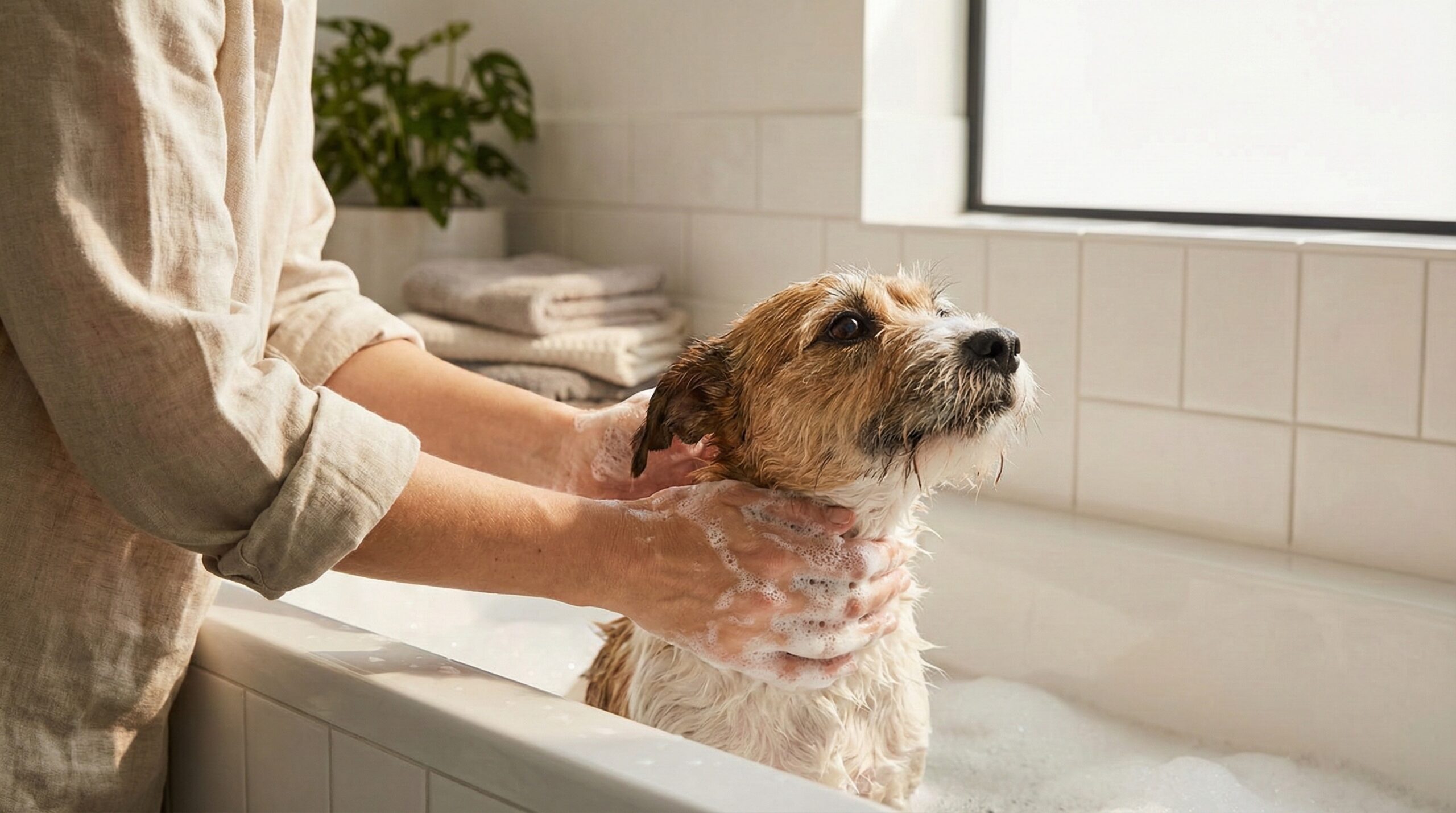
It’s easy to blame the tool when a dog gets itchy afterward — but for sensitive skin, bathing and residue are just as important as brushing technique. Mechanical friction + a drying shampoo (or insufficient rinsing) is a common one-two punch.
Separate the roles: tool vs. shampoo
- De-shedding tools are mechanical friction. They can irritate if used too firmly or too long.
- Shampoo/conditioner affects the skin barrier. Some formulas are fine for one dog and irritating for another, especially if there’s a history of topical sensitivity.
Contact time matters for sensitive dogs
Evidence and owner feedback suggest that “leave it on for X minutes” directions may be too aggressive for some reactive dogs — especially if they’re already itchy. If you want to try a de-shedding bath product, consider a patch test and start with a shorter contact time than the maximum, then adjust only if the skin stays calm.
Rinse longer than you think you need to
Soap or conditioner residue can cause itching that looks like a grooming-tool problem. For sensitive skin, err on the side of extra rinsing, especially around the chest, armpits, and belly where product can linger.
Don’t groom through a flare-up
If your dog is actively inflamed (red, hot, itchy, or has lesions), pause grooming and focus on the cause — fleas, environmental allergies, food sensitivities, yeast/bacterial infection, mites, etc. The AVMA has general pet care guidance that supports the “if something looks wrong, consult your veterinarian” approach; with skin issues, earlier help often prevents a small irritation from becoming a bigger infection.
When to report a suspected product reaction
If you believe a grooming product caused a significant adverse reaction (for example, widespread welts, facial swelling, intense itching, or sudden hair loss), stop use and contact your vet. You can also file a report through the FDA Center for Veterinary Medicine (CVM) so patterns can be tracked.
What to check on the label (and in your routine) if your dog is sensitive
We can’t diagnose skin problems in a grooming review, but you can make smarter, lower-risk choices by checking a few practical things.
For de-shedding shampoos/conditioners
- Fragrance level: Heavily scented products are more likely to bother sensitive dogs.
- Directions: If a product requires a long contact time, plan a patch test first and rinse thoroughly.
- “De-shedding” claims: These often rely on conditioning agents that help hair slip out. Great when tolerated; irritating when not.
For de-shedding tools
- Correct size/model: A mismatch can lead to too much hair removal and more passes to “get results,” raising irritation risk.
- Your frequency: Sensitive dogs usually do better with occasional use (seasonal) than frequent sessions.
- Your dog’s behavior: If your dog gets more reactive with each session, treat that as a stop sign — not something to “push through.”
If your dog is “sensitive” because of chronic itch
Ongoing itch (pruritus) is commonly tied to underlying causes that grooming can’t solve. If your dog licks paws constantly, rubs face, or has recurring ear issues, a grooming tool is unlikely to be the fix — your vet is.
FAQ
Can a FURminator cause bald spots or coat damage on sensitive-skin dogs?
Yes. Bald spots, a “thinned” look, or a rough-feeling coat are most often linked to overuse (too long, too often), too much pressure, or too many repeated passes in one area. Stop, let the coat recover, and switch to a gentler tool if your dog’s skin is easily irritated.
How often can I use it on a sensitive dog?
Start very infrequently with short sessions, then only increase if there’s no redness, itching, or agitation. Many sensitive dogs do best with occasional seasonal use rather than weekly de-shedding.
What should I do if my dog is itchy after using it?
Stop using it and check the skin closely for redness or tiny scratch-like marks, especially on thin-fur areas. If you bathed your dog too, consider whether shampoo residue could be causing itch — re-rinsing with plain water sometimes helps. If itching persists or you see sores, talk to your vet and consider underlying causes like fleas or allergies; the ACVD’s pruritus (itch) education is a useful starting point for understanding what chronic itch can mean.
Is it safe to use on hot spots or irritated skin?
No. Avoid all de-shedding tools (and anything that adds friction) on inflamed or broken skin. Hot spots and rashes can worsen quickly with irritation; pause grooming and contact your vet for treatment guidance.
What’s the gentlest alternative that still reduces shedding?
For truly reactive skin, a rubber curry brush or grooming glove is usually the gentlest option. If you need more undercoat lift than a glove can provide, a rounded-pin undercoat rake is often a middle ground — effective, but typically less scrape-prone than aggressive de-shedding blades.
Should I use a de-shedding shampoo and a de-shedding tool together?
You can, but be cautious with sensitive skin. Combining them can reduce overall brushing time (a plus), but it also stacks potential irritants (friction + product exposure). Patch test new bath products, keep contact time conservative, and stop if you see redness or a spike in itching.
When should I contact a vet about “sensitive skin” instead of changing grooming tools?
Contact a vet if your dog has recurrent itching, hot spots, scabs, odor, greasy skin, hair loss, ear infections, or redness that returns quickly after baths. Those patterns often point to allergies, parasites, or skin infection — issues that need diagnosis and treatment, not more brushing.
Bottom Line
A FURminator can work for sensitive-skin dogs when the skin is healthy and you use a very light touch, short strokes, and infrequent sessions. The moment you see redness, increased scratching, or any sign of inflamed skin, stop and switch to gentler grooming (or address the underlying itch with your vet). For many sensitive dogs, the safest “win” is using de-shedding products to shorten grooming time — not to push harder with the tool.
Affiliate disclosure: Some of the links in this article are affiliate links, meaning we earn a small commission if you make a purchase.